

25 years
Isle of Islay
Gaelic:
An t-Eilean Ileach
Previous Names:
Current Status:
Type:
Callsign:
IMO:
MMSI:
Launched:
Acquired:
Entered Service:
Disposed:
In current service with CalMac
Steel MV
MOBV4
9970923
232049280
16/03/24
31/03/26
Details
Ordered By:
Cost:
Registered:
Launched by:
Named after:
Caledonian Maritime Assets Limited (CMAL)
£45.5m
Glasgow
Morag McNeill, Chair of CMAL
Islay - the southernmost island of the Inner Hebrides of Scotland.

Dimensions
Length:
94.8m
Draught:
Breadth:
4m
18.7m
Gross Tonnage:
8680
Technical
Builders:
Cemre Shipyard, Turkey
Yard No:
1092
Engine Builders:
2x Voith Schneiders (stern), 2x Bow Thrusters
Machinery:
Speed:
16.5
Hoist & Lifts:
Remarks:
First of four sister vessels to be introduced through 2026 and 2027.
Capacities
Passengers:
Cars:
Crew:
Lifeboats:
450
107
27
Facilities
Route Timeline
2026 - Present: Kennacraig - Port Ellen / Port Askaig
Current, Last or Usual Route

Kennacraig - Port Ellen / Port Askaig
History
March 2022 saw the contract for two new ferries awarded to the Cemre shipyard in Yalova, Turkey. Unlike the protracted contract for what would become Glen Sannox and Glen Rosa, this order made no mention of complex dual-fuelling or LNG—a source of immense difficulty for the ships constructed at Port Glasgow. Instead, the design focused on a proven, efficient diesel-electric hybrid powertrain backed by battery storage, intended to provide dependable service while easing carbon emissions across the southern Hebrides.
The first of what was to become known as the Islay Class began construction on 3rd October 2022 when the first steel was cut. The next major milestone arrived in mid-January 2023 when her keel was laid (coinciding with first steel being cut for her sister ship on an adjacent slipway). Fabrication progressed steadily through the remainder of 2023 and into the spring of 2024 as both hulls rose side by side.
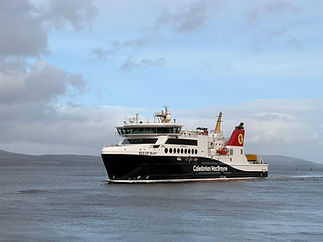
When public consultation opened to christen the pair, the lead vessel was ultimately given the ultra-unimaginative moniker Isle of Islay. She was launched stern-first into the Sea of Marmara on 16th March 2024, cutting a remarkably sleek figure once afloat with distinctive twin angled funnels and swept-back masts. Although fitting out was originally slated for completion by late 2024, wider supply-chain bottlenecks and outfitting refinements pushed her handover back into early 2026.
At 94.8 metres in length with an 18.7-metre beam, Isle of Islay delivers a welcome 40% boost in freight and vehicle capacity compared to the veteran tonnage she was designed to replace.
The vehicle deck features an open-plan layout accommodating up to five lanes of cars or four lanes of commercial traffic, flanked by twin mezzanine decks (one single-lane and one double-lane, echoing the arrangement on Loch Seaforth). Access forward is handled via standard clamshell bow visor doors and an inner folding ramp, while her stern ramp shares the versatile offset-hinge design seen on the 802 class, capable of slewing port or starboard to marry cleanly with varying shore linkspans.
Passenger accommodation and crew quarters occupy two dedicated decks above the vehicle space. Internally, the accommodation is airy and contemporary, incorporating quiet lounges, a coffee shop, a family area, and a self-service restaurant. While an open exterior deck is accessible aft and directly between the towering funnels, enthusiasts will note with some regret the complete absence of forward-facing open deck space—a much-loved hallmark of long-serving predecessors like Hebridean Isles and Isle of Arran.
Following exhaustive sea trials in the Sea of Marmara, Isle of Islay was officially handed over to owners Caledonian Maritime Assets Limited (CMAL) on 15th January 2026.
Her delivery voyage got underway eight days later on 23rd January, embarking on a winter passage across the Mediterranean. Calling at Gibraltar for bunker fuel, she navigated the Atlantic seaboard and tackled a typically boisterous winter crossing of the Bay of Biscay. A month after setting sail from Turkey, she made her grand arrival on the Firth of Clyde on 22nd February 2026, tying up at Inchgreen Quay in Greenock. Here, she underwent final MCA coding inspections, livery detailing, and CalMac technical equipment installations.
Throughout early March 2026, she could be seen touring the network, conducting comprehensive berthing trials at Kennacraig, Port Askaig, and Port Ellen, as well as testing linkspan clearances at Brodick, Oban, and Castlebay. Alongside technical trials, extensive crew familiarisation ensured her master and crew adapted to the hybrid propulsion controls and twin azimuth thrusters.
On 31st March 2026, Isle of Islay made her long-anticipated commercial passenger debut, taking up scheduled roster duties on the Kennacraig to Port Askaig route to a warm reception from islanders and freight operators alike.
As is customary with complex prototype tonnage, her initial months in service brought a handful of teething snags. Minor hydraulic gremlins with the bow visor locking pins and calibration adjustments on the mezzanine hoists occasionally surfaced during her early weeks, temporarily necessitating stern-only drive-in/reverse-out loading patterns while shore technicians ironed out software parameters.
Demonstrating her intended route versatility, she was briefly pulled from the Islay run in late April 2026 to provide short-term emergency relief on the arduous Oban–Castlebay (Barra) crossing, proving her sea-keeping abilities in open Atlantic swells before returning to anchor the primary Islay timetable ahead of the summer peak.
Gallery


